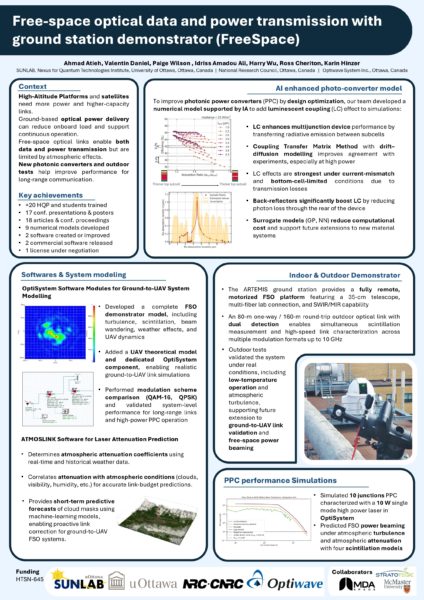

Optiwave, in collaboration with the uOttawa SUNLAB and the National Research Council (NRC), has successfully concluded the FreeSpace program. This initiative developed and validated free-space optical (FSO) links for data and continuous power transmission to High-Altitude Platforms (HAPs) and satellites.
Ground-based optical power delivery is critical to reducing onboard payload requirements , and this project successfully addressed atmospheric limitations through advanced software simulation and outdoor hardware testing.
Key Commercial Software Advancements
The project generated nine new numerical models and resulted in two commercial software releases:
- AI-Enhanced PPC Modeling: We developed AI-supported numerical models utilizing surrogate models (GP, NN) to simulate luminescent coupling (LC) in Photonic Power Converters (PPC). This significantly reduces computational costs while enhancing multijunction device performance for high-power operations.
- Ground-to-UAV OptiSystem Modules: OptiSystem now features a complete FSO demonstrator model. Engineers can accurately simulate ground-to-UAV links by modeling atmospheric turbulence, scintillation, beam wandering, and realistic UAV dynamics.
- ATMOSLINK Software: A new predictive tool that uses real-time weather data and machine learning to forecast cloud masks and atmospheric attenuation for proactive FSO link correction.
Real-World Outdoor Validation
Theoretical models were rigorously validated using the ARTEMIS remote FSO ground station, which features a 35-cm telescope. The team successfully characterized a 160-m round-trip outdoor optical link across multiple modulation formats up to 10 GHz. This proved the system’s viability under real atmospheric turbulence and low-temperature conditions.